
Managing Your Retirement Plan through the Market Turmoil
9 min read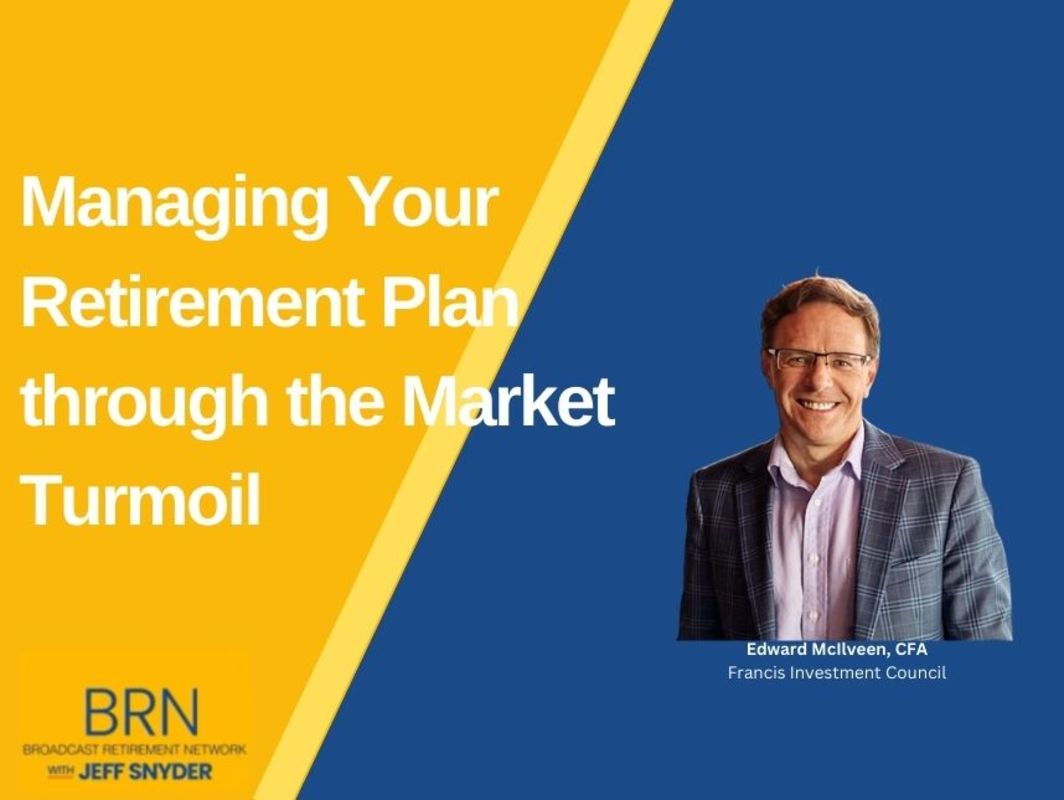
Broadcast Retirement Network’s Jeffrey Snyder discusses how to manage your retirement plan through volatile markets with Francis LLC’s Edward McIlveen, CFA.
Jeffrey Snyder, Broadcast Retirement Network
Joining me now is Edward McIlveen, CFA of Francis LLC. Ed, great to see you. Thanks for joining us this evening.
Edward McIlveen, CFA, Francis LLC
Thank you very much. Thank you for having me.
Jeffrey Snyder, Broadcast Retirement Network
Yeah, this has been kind of a challenging time in the markets. We’re going to get into that, but I want to start off with a base question. What are you hearing from clients and their employees or what we would call in the retirement industry participants about all this market volatility?
Edward McIlveen, CFA, Francis LLC
Yeah, I think the people that are probably just asking the most questions right now are those that are coming into retirement, those that are in the 55 to 59, 60 years of age that are thinking about, all right, I have built up a good size nest egg, something like this. Is there another time for me to take a look at my asset allocation? Should I make some changes?
And so from our standpoint, our messaging really has been around, well, if you’ve got your goals met, if you feel like you’ve paid down debt and you can take risk on a longer term timeframe, this is not the time to really be getting more defensive. If anything, be a little bit more interested in stocks, not just U.S. stocks, but also international. And then- Go ahead.
Jeffrey Snyder, Broadcast Retirement Network
I’m sorry. No, no. Finish your thought.
I’m sorry for interrupting you.
Edward McIlveen, CFA, Francis LLC
Oh, yeah. No problem. And then the other folks that we’re talking to are more or less, I’ll call them opportunistic.
Hey, is there something here that really just stands out in this dislocation that we should be thinking about a little bit more? And for those folks, what we’re really interested in doing is just making sure we talk about changing things on the margin. There’s no need to go all in or all out of a particular asset class, of course.
This is about, all right, maybe just put a little bit more into U.S. equities, a little bit more into emerging markets and a little bit more into international. And why is that? It really comes down to just the history of geopolitical events.
And I want to be really sensitive to the reality that we’re talking about war and we’re talking about things that are very unpleasant. And so hopefully your audience and everybody appreciates that in the context of all that, that there’s a human factor, there’s a humanity component of this. And so from my standpoint, as what do we talk about with clients, it really is taking a step back and looking at history and how does this impact your savings?
And for the most part, you can go back into the mid-1950s forward and find about 60 different geopolitical events and really all but a handful. Twelve months after the event takes place, the market is either recovered or it’s actually meaningfully ahead from those particular flashpoints. So hopefully that makes sense to you and your audience as well, to just kind of balance the reality that, yeah, there’s a human element here that we want to be just recognizing.
And then as a saver and as a long-term investor, that we’re not going to react to the emotion, which is very understandable in that regard.
Jeffrey Snyder, Broadcast Retirement Network
Yeah, I can only imagine. I have not spoken to our record-keeping colleagues, but I’m sure the chatbots are ringing off the hook. I don’t even think people use phones anymore.
They’re just using chatbots, but I’m sure there’s a lot of queries going on. You bring up history. And when I first saw this event unfold, this attack and the spike in oil, I immediately thought about 12 months ago or 13 or so months ago when we had the tariffs put into place.
And if you recall, Ed, there was a significant decline because the market was trying to price in these tariffs. This is kind of analogous to that. It’s a different market event, but similar in the result.
And at the end of the day, like you said, the market came back on those tariffs and came back, they really did.
Edward McIlveen, CFA, Francis LLC
Yeah, there are certainly parallels to this. And when we look at not only just the equity market, but really encourage investors to look at the bond market and the bond market has a really wonderful way. It’s not perfect, but it is pretty smart.
And just kind of snipping out, right, what are the inflationary impacts from an event like this? You see a big spike in the price of oil. You see the tariffs hit.
And whether it was the tariffs or even most recently with this war in Iran, we have not seen a material change to inflation expectations. Inflation expectations, you’re looking at the difference between nominal yields on bonds versus bonds that do change, that do adjust treasury inflation protected securities. And right now that implies, you know, on a forward basis of next five years, about just a little bit more than two and a half percent.
That’s true today. That was also true right around the period of the tariffs being released. So while there’s this huge gyration within the equity markets and in some of the commodity markets, we always encourage investors to look at the bond markets, because that does give us a good signal about inflation, as well as what future economic growth looks like.
And just like the tariff environment to today, when you look at these things between the shape of the yield curve, it is upward sloping. It is traditionally a signal that there is economic growth ahead versus recession.
Jeffrey Snyder, Broadcast Retirement Network
You brought up, you know, nibbling on it, paraphrase what you said, nibbling around the edges in terms of diversification and asset classes. Does the, you know, I grew up in the 60-40 split era. So when I think about the moderate balance portfolio, I think about target day funds.
I think about some of the managed portfolios. Does that strategy still hold true today? You know, we’ve got a lot of volatility today, the past few weeks or days, the past week I would say, but we had volatility last year.
But this, does that portfolio strategy, that diversification still hold true today?
Edward McIlveen, CFA, Francis LLC
Largely, yes. There’s a nuance that we have talked about with our clients for a handful of decades now, and that is thinking a little bit more about anything that is inflation sensitive. So within the 60-40, 70-30 portfolio, why not carve out a component, call it 5% towards a commodities basket that has some inflation sensitive properties?
Why not carve out some treasury inflation protected securities within your fixed income? And also, believe it or not, emerging market debt is a very powerful diversifier. But in like all these things, when you’re diversified, you don’t really have more than 5%, 8% within a portfolio that’s going to make this up.
So as you think about these different economic environments that we come in and out of, and of course, we never really know when we’re going to hit a high inflationary environment, or if things are going to turn south on the growth front, you need to have a lot of things covered from an overall economic growth profile and inflationary profile. So when we think about retirement plan investors having an asset class like commodities, and I’m talking about a commodities index product or something that is like that, broadly diversified, many different contracts, majority of it is in energy, about half of it is in energy. And I’m thinking about the UBS Prompt Index, formerly known as the Credit Suisse Commodity Benchmark, 50% or so in energy, and then you got a quarter that’s in metals, both precious and industrial, and another quarter that’s going to be in agricultural.
Because again, you never know which commodity it is that you’re going to hedge with. But I think sometimes retirement plan investors, one of the things that we hear, and I just had a phone call with an individual today was, should I be thinking about platinum? Should I be thinking about gold as standalone options?
And to us, they can be part of a broadly diversified component within commodities and something that’s inflation sensitive. But going back to the whole idea of being diversified and the 60-40 or the 70-30 portfolio, it broadly holds with the belief that we have that you want to have something that’s more inflation sensitive embedded with it. And that’s been one of our core philosophies now, like I said, for a couple decades plus.
Jeffrey Snyder, Broadcast Retirement Network
And so for these upcoming meetings, and I don’t want you to give away the secret sauce here, but when you go to visit with clients, and for those unfamiliar with our industry, there’s generally quarterly meetings, you sit down with the fiduciaries, they have a responsibility to the benefit, the participants receiving benefits. Are there, do you recommend these asset classes? Or is it like, hey, we can do this, but the chances of adding a fund in the next 30 days, procedurally, operationally, that’s not going to be done in 30 days.
It may not even be done in 60 days, there’s communication, there’s operational challenges. So are these conversations that you have to set the groundwork for the future?
Edward McIlveen, CFA, Francis LLC
Yeah. And anytime we start working with a client, this is all part of our onboarding. We take almost all of the clients that we look at initially, they have the traditional asset classes covered in spades.
It’s really these inflation sensitive components that need to be brought into the discussion. So to your point, you’re absolutely right. If you haven’t done this, now, putting in something that is commodities sensitive or oil sensitive, whatever you want to call it, now, it just doesn’t feel like it would certainly be the right time, opportunistically speaking.
But thinking about it from a much broader picture of, all right, what do we want to have to offer our participants? So they have the tools, and that committee, as a 401k committee, they’re not managing the money. They can just make the tools available, and a participant can make a decision around that.
And that’s where education comes in and making people aware of what their opportunities are and using them sparingly. It is important also, I think, to note that sometimes when these kinds of products are put into plans, there’s a fear that they’re going to be misused. And from what we have seen, it is very, very unusual for participants to actually say, you know what?
I just saw oil go up X number of percentage. I better put half of my account in that commodity fund and really get this thing cranking. That is a very, very unusual situation to come across.
We don’t really see more than, like I said, this 5% target and less in an individual portfolio. That’s really where it sits, with and without communication, with and without education, and sitting down with people as well.
Jeffrey Snyder, Broadcast Retirement Network
Yeah. These are conversations that should be had, and I know that you and your team do that. You always deliver a state of the economy where things are, and that helps set the table for future decisions.
Ed, we’re going to have to leave it there. Great to see you. Thanks for joining us.
Look, we look forward to having you back on the program again very soon, sir.
Edward McIlveen, CFA, Francis LLC
Great conversation. Thank you so much, Jeff.
#Managing #Retirement #Plan #Market #Turmoil