
Building the Best Retirement Plan Line Up: Reaction to the Proposed U.S. Department of Labor Regulations
8 min read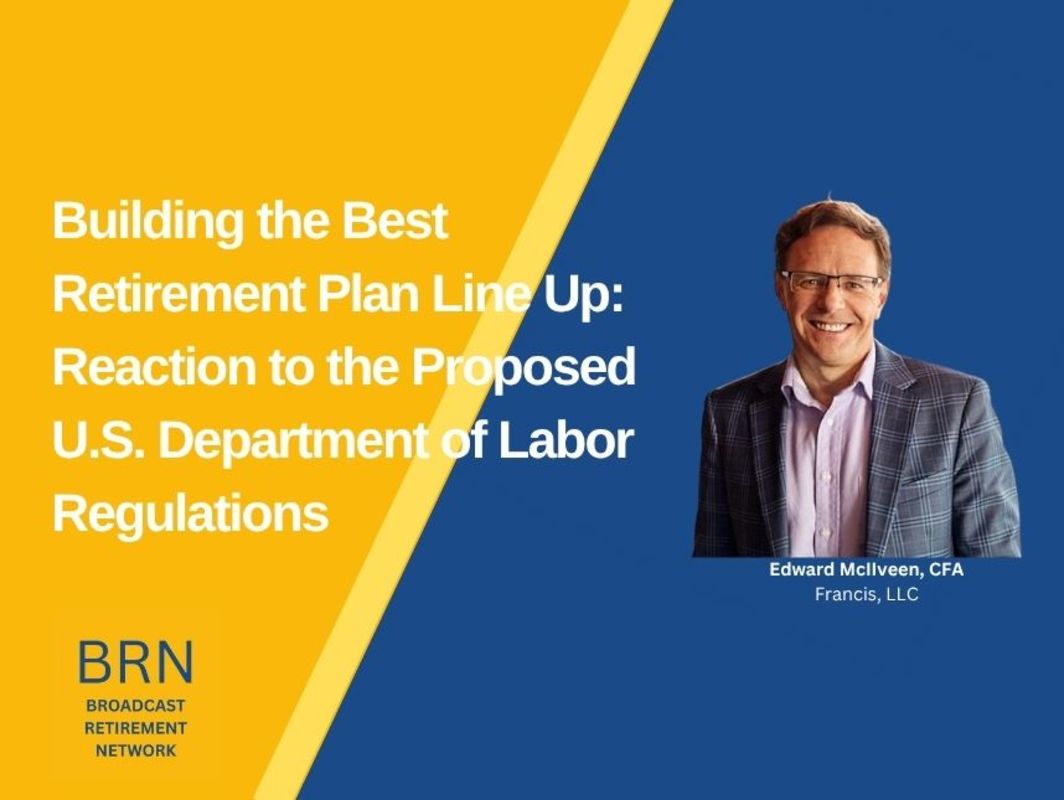
Broadcast Retirement Network’s Jeffrey Snyder discusses the impact of the new U.S. Department of Labor regulations on designing retirement plan investment line ups with Francis, LLC’s s Edward McEIlveen, CFA.
Jeffrey Snyder, Broadcast Retirement Network
Well, joining me now is Edward McEIlveen, CFA. He’s the Chief Investment Officer for Francis, LLC. That is a registered investment advisory firm.
Ed, welcome back to the program. Great to see you this morning.
Edward McEIlveen, CFA, Francis, LLC
Thank you so much, Jeff, for having me.
Jeffrey Snyder, Broadcast Retirement Network
And I can’t tell you, it always feels like deja vu. I don’t know why. But let me start with the baseline question here just to kind of set things up.
In your mind and Francis’s mind, what makes a successful, not just good, not just great, a successful retirement plan investment lineup?
Edward McEIlveen, CFA, Francis, LLC
Well, we like to address three different kinds of investors. And we think we can address not only just those three kinds of investors through having different pockets of investment opportunities, but also address economic environments, whether it’s gonna be a high growth, low inflation, or something that’s higher inflation and lower growth. And so the three kinds of investors that we’re trying to address here, number one, they do it for me.
And that is someone that’s gonna be using target retirement date funds, put something in the mix, make sure you make your contributions on a regular basis, let it grow over time. The second investor is the one that is really looking for just index options. And so just think about the mantra, give me indexing or give me death type of thing.
And so for that kind of investor, they just wanna own the market, we’ll give them options to address that as well. And then the third investor is the individual that’s looking for more tools. And so this can be an actively managed small cap growth fund, maybe an emerging market debt fund, as well as some kind of commodities fund.
And when we think about what is gonna be successful over the long term, target retirement date is gonna be the first and foremost place to go, because if someone’s doing this for you, it almost sounds like it’s too easy at times. All we have to do is just use this one fund, it’s gonna change over time and have a different asset allocation. And it costs a very competitive fee relative to certainly going outside or trying to manage it through a high net worth environment.
Those are things that we think from a cost competitiveness standpoint, as well as just giving people options to use, lets them make sure that they’re able to pursue different ways of thinking, what they view as being best for their retirement goals.
Jeffrey Snyder, Broadcast Retirement Network
Yeah, well, you’re certainly catering as an employer offering a plan, you’re catering to everybody. And so you have to make sure that you have the widest swath of offerings available so that you keep people satisfied and ultimately saving for their financial future and independence. So with all that in mind, Ed, you probably peruse the 140 some odd pages of the new US Department of Labor proposed regulations.
I wanna get you as the chief investment officer and someone who does this each and every day, what’s yours and Francis’s reaction to those regs? How did they meet your standard in terms of your processes?
Edward McEIlveen, CFA, Francis, LLC
Well, Pat, but from an initial reaction standpoint, there’s a lot of things that have been covered. And we tend to think that the DOL has done a pretty good job of outlining what it needs to do. And so from the standpoint of understanding what the direction is and where they wanna take things, they give about 20 examples going through all the different ways that plan sponsors can be thinking about evaluating investment alternatives.
So I think the framework and the examples that are provided are pretty doggone helpful. As far as the prudence that it is addressing, I’ll tell you that there’s enough examples that are out there that would, I think, just align with a lot of things that we’re currently doing with our own investment process. The one aspect of this that is concerning is around just thinking about some of the, I’ll say innovative investments or new structures that are being proposed that don’t have a long-term track record.
And if we don’t have a long-term track record to evaluate, then there’s a use of expected returns based off hypotheticals or simulations of assets that would behave similarly to the one that is being proposed. And that to us is really, we have to take a step back and think about when we put something into a retirement plan, we want it to be at least time-tested. And what is the time that you need?
And it’s typically gonna be seven to 10 years. And so if there is a new asset that is being evaluated and plan sponsors will now have a framework in which to consider this so they can have the safe harbor provision, that’s one consideration here to open up more dialogue and discussion. However, is that really in the best interest of everybody that’s in the plan?
And so we’ve had instances where certain plan sponsors have had members of their team wonder, hey, can we have a Bitcoin fund? Can we have some kind of private credit vehicle that we just heard about from a sales rep that touched base with us and so on? So this kind of environment that now exists with this proposed rule, it’s not in effect, but it will be at some point in the not too distant future, this is gonna allow for greater discussion and a wider array of discussion, which is good, which is healthy.
And so we’re not opposed to that at all. Just this whole aspect of not having the time-tested nature of an asset that’s being considered and having more of a hypothetical discussion around it, we find that to be something that I think we need to have a little bit more of a perspective there that may not be in the best interest of the plan sponsor, but that’s for the plan sponsor to decide. And that’s what the DOL is doing is giving them this asset neutral capability to view things and to be able to make a decision around that.
Jeffrey Snyder, Broadcast Retirement Network
Reaction, so that’s yours, Francis’s reaction, obviously very important part of the marketplace in terms of ideas. Are you hearing things from clients? You mentioned you had one client in the not too distant past come back and say, hey, we’d like to consider a Bitcoin fund.
Okay, but since the release of these new regs, are they beating down your door or calling you on the phone and saying, let’s get a meeting together? What’s the initial client reaction that you can share?
Edward McEIlveen, CFA, Francis, LLC
Yeah, it’s pretty quiet. And I think it is mainly because, we’re looking at 140 pages of information. And when you ask them questions about just the regular old, hey, what’s happening within the stock market?
Most people, they’re doing other things. Most plan sponsors are not in this business. And some of the participants, they do have a very sophisticated base, but this is something that is not really rising to the top of like why the phone would be ringing.
If anything, it’s much more around in just the time that we’re recording this. It’s around everything related to the geopolitics that are going on in 2026.
Jeffrey Snyder, Broadcast Retirement Network
Yeah, I would imagine that affordability, all the things, I think we’ve talked about this in the past and I’ve talked about it with others. They seem to take priority, the short term versus the long term. Although maybe the short has an impact, certainly has an impact on the long term.
Ed, I wanna kind of end where we kind of started. You told us from your perspective and Francis’s perspective, what makes a successful investment lineup? How much of what we’re talking about today, you can build the framework, you can build a great investment lineup, but at the end of the day, isn’t it all about participant education?
So even with this new framework, wouldn’t you imagine or do you imagine that participant education, employee education will need to continue or actually be bumped up to explain a lot of these concepts that you and I and the audience are listening to today?
Edward McEIlveen, CFA, Francis, LLC
Oh, it’s gonna have to be ramped up and there’s gonna have to be really just kind of like a mind shift here about how do we think about liquidity? And if we are going to have structures that are in retirement plans that may not be as liquid over a certain timeframe as what has come to be expected. Right now, participants didn’t go into their accounts, they can make changes and they’re able to move things around pretty easily.
With a private equity solution or some kind of private credit solution, that may or may not be the case. And so from a transparency standpoint, helping participants understand what it is that they own, seeing some of the projections that have been put out from some organizations that were supporting this regulation, they’re looking at pretty wide changes in terms of what asset allocation would look like by including private equity. And so because these are so significant in terms of expected changes, I think we have to also appreciate that plan participants are gonna need to know what it is, what do they own, why they own it.
And furthermore, having again, kind of that mental mindset shift where you’re no longer really thinking about going in and monitoring things every single day or maybe potentially making changes every day, but having a longer term time horizon around it to just understand, well, what is this product that is in the mix and what should I do and how can I interact and engage with it going forward?
Jeffrey Snyder, Broadcast Retirement Network
Well, education is important. I know you and the Francis team do a lot of education. It’s core to what you do.
Ed, I can’t thank you enough for coming on the program. Great to get your reaction. Great to get your feedback.
And look, we look forward to having you back on the program again very soon, sir.
Edward McEIlveen, CFA, Francis, LLC
Thank you so much. I appreciate it, Jeff.
#Building #Retirement #Plan #Line #Reaction #Proposed #U.S #Department #Labor #Regulations