
From drought to demand: Biotech IPOs roar back with Kailera and Alamar
3 min read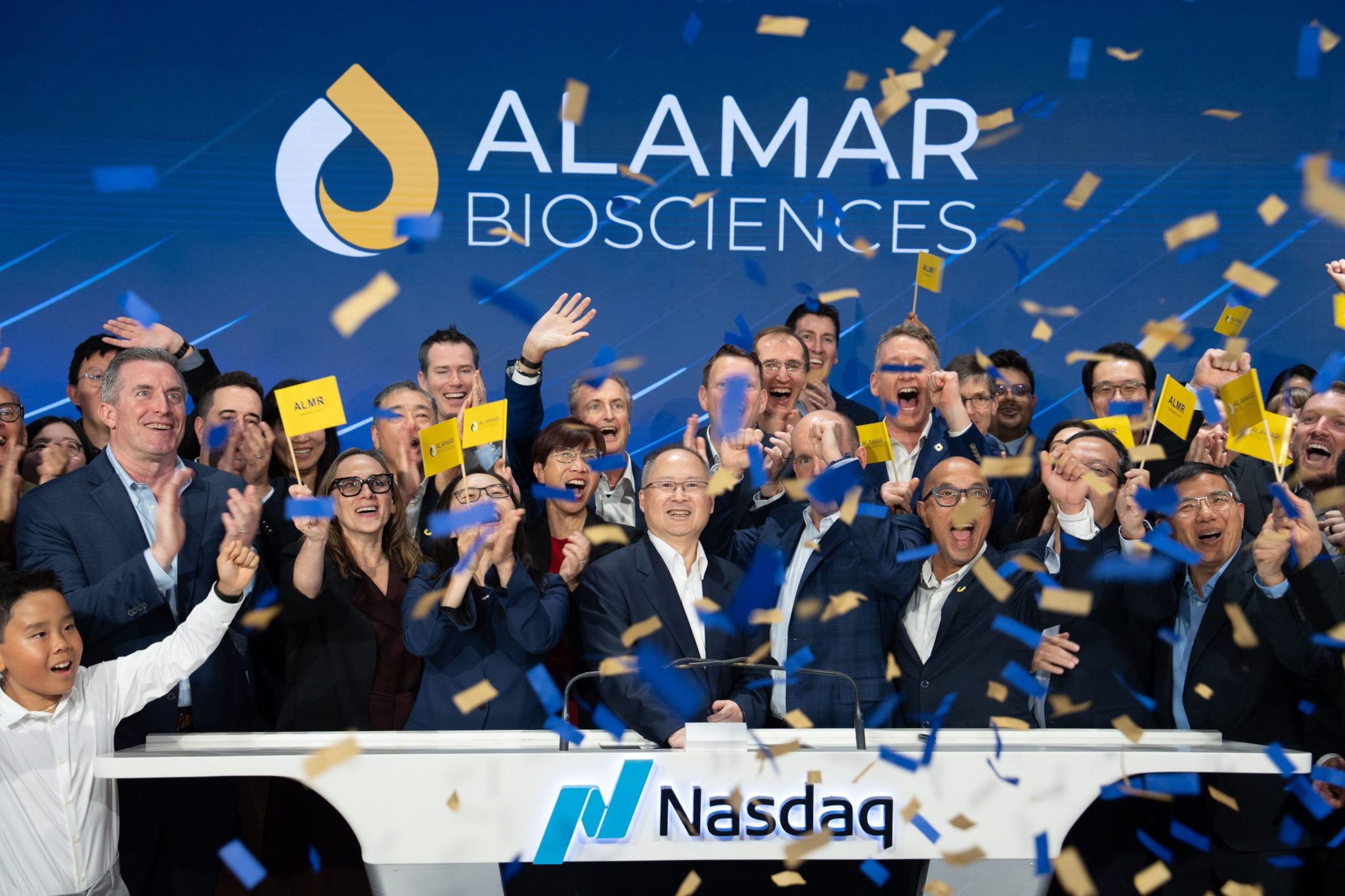
Yuling Luo rang the Nasdaq closing bell Friday having taken his first company public in a massively oversubscribed round. The Alamar Biosciences CEO’s IPO was one of two back-to-back blockbuster biotech offerings this week, a clear signal that investors are willing to open their wallets for life sciences companies again—under the right conditions.
On Thursday, Kailera Therapeutics, an obesity drug developer, raised $625 million in what is believed to be the largest biotech IPO in Nasdaq history. The IPO priced 39.1 million shares at $16 (the top of its range). The company had initially set out to raise just $500 million. One day post-IPO, Kailera was already up 63 percent.
On Friday, Alamar Biosciences, a precision proteomics (the study of proteins rather than genes) firm, priced its own upsized offering at $17 per share (the top of its range) raising $191.3 million after demand exceeded available shares by 11 times, Luo told Fortune. Much like Kailera, Alamar shares soared, up 33% on the first day of trading.
For Alamar in particular, the listing carries symbolic weight. The life sciences tools and diagnostics sector has been effectively shut out of the public markets since 2021, when
MedTech IPO activity peaked at 61 companies going public. A brutal stretch followed: Only two U.S. MedTech companies went public in each of 2022 and 2023, according to FLG Partners data. The tools sub-sector, where Alamar operates, has remained dormant.
Luo attributed the IPO drought—and Alamar’s ability to end it—to a long-awaited technological breakthrough in early disease detection of cancer and Alzheimer’s. The company’s platform can detect disease signals in blood that are too faint for existing tools to pick up. He compared the product’s detection capabilities as being able to read an eye exam chart from 37 miles away.
“I think that’s why it’s been five years, because investors now see the great potential in proteomics. Everyone recognizes we finally have technology that could unlock it,” Luo told Fortune. He sees proteomics as the next frontier after genomics: where gene-sequencing gives doctors a static snapshot of a patient’s DNA, protein analysis offers a real-time window into how disease is actually unfolding inside the body.
Alamar operates in a market valued at over $36 billion in 2025 and expected to reach $65.8 billion by 2030. The company tripled revenue from $25 million to $74 million in two years despite what Luo called “one of the most difficult market environments” for the tools industry.
Kailera is staking its claim in an even hotter opportunity and space: the global obesity GLP-1 market, currently worth roughly $10 billion and projected to reach $66.57 billion by 2035, growing at a 23% CAGR. The company is going head-to-head with Novo Nordisk and Eli Lilly, developing injectable and oral GLP-1 agonists.
The back-to-back pricings arrive at a complicated moment for biotech more broadly. Private bio/pharma funding in 2025 totaled roughly $40 billion across 1,045 deals, essentially flat with 2024. Meanwhile, the overall venture market has been dominated by AI. About 80% of global venture capital in Q1 2026 flowed to AI companies, with four mega-deals (OpenAI, Anthropic, xAI, and Waymo) accounting for more than $188 billion of the record $300 billion quarter. That dynamic has squeezed attention and capital for non-AI sectors, even as PitchBook data showed biotech deal activity climbing back to its highest level since late 2022 in Q4 2025.
The broader IPO market has struggled to find its footing too: early 2026 listings were “much slower than was expected,” Crunchbase research lead Gené Teare previously told Fortune, with attention consumed by AI giants like OpenAI, SpaceX, and Anthropic that have yet to list. When they do, Teare said, it could “create a lot of energy in the markets for other companies to also go out”—or simply crowd everyone else out.
Analysts had projected 30 to 35 biotech IPOs for 2026. This week’s deals suggest the window may finally be cracking open—at least for companies with late-stage data and differentiated science to show investors.
#drought #demand #Biotech #IPOs #roar #Kailera #Alamar