
Wall Street sees ‘nothing of real substance’ in Trump’s China trade deal—and stocks are selling off
7 min read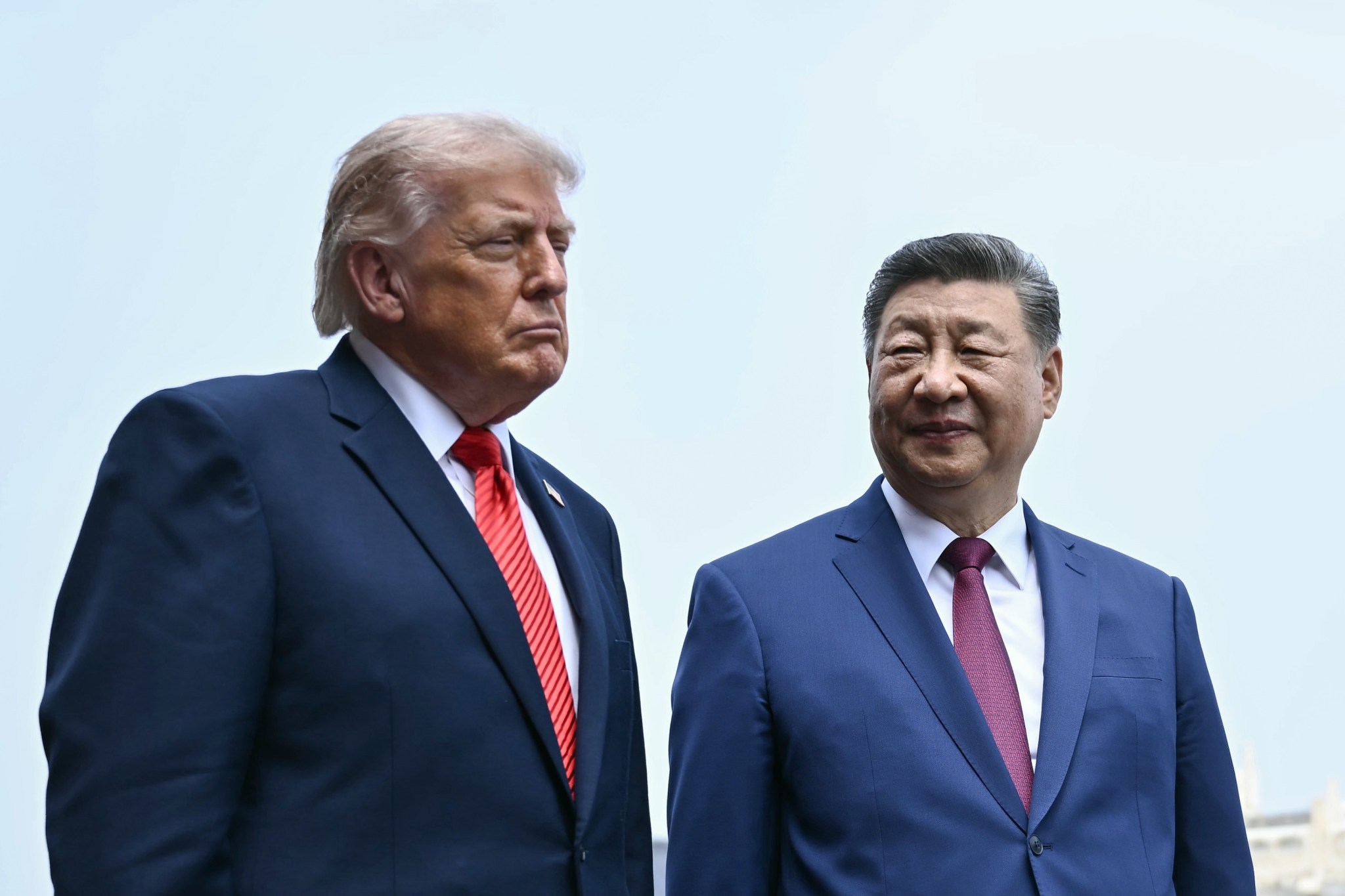
Quick note: Subscribe to the forthcoming Fortune Gulf Brief. Every Tuesday, this new newsletter will deliver clear-eyed, authoritative intelligence on the deals, decisions, policies, and power shifts shaping one of the world’s most consequential regions, written for the people who need to act on it. Sign up here.
THE MARKETSWall Street unimpressed by Trump’s ‘fantastic trade deals’ with China
S&P 500 futures were down 1% this morning. The index was up 0.77% yesterday.
In Europe, the Stoxx 600 was down 1.28% in early trading and the U.K.’s FTSE 100 was down 1.42% before lunch.
Asia: South Korea’s KOSPI down 6.12%. Japan’s Nikkei 225 was down 1.99%. India’s Nifty 50 was down 0.13%. China’s CSI 300 was down 1.12%.
Brent crude was up to $109 per barrel this morning.
Bitcoin was at $80.5K.
Stocks are selling off globally this morning after President Trump returned from his summit with China’s Xi Jinping but gave few specifics about what was achieved. Every major index in Asia and Europe was solidly down. The volatile South Korea KOSPI lost more than 6%; China’s CSI 300 was down 1.12%. In the U.S., S&P 500 futures were off 1% before the opening bell in New York.
“Only” 200 jets. Boeing stock lost 4.73% yesterday and a further 1.38% in overnight trading after Trump announced that China agreed to order 200 planes from the company. On Trump’s previous trip to China in 2017, 300 aircraft were sold. Prior to this trip, White House sources had suggested 500 planes might be sold.
The Wall Street Journal’s live coverage summed it up best:
“Trump told reporters that both he and Xi want the conflict in Iran to end and for Iran to not have a nuclear weapon. He said that the two leaders had made “fantastic trade deals,” without providing details. China’s government said it had reached “a series of new common understandings” with the U.S., but didn’t say what those entailed.”
Investment bank analysts were largely disappointed
“Much increasingly scarce jet fuel has been burned to produce nothing of real substance. China’s President Xi declared an agreement to keep trade ties stable. The two sides were unlikely to agree to anything different (no one would announce unstable trade ties). Stability is not a word that is normally associated with U.S. trade policy over the past 15 months, lessening the statement’s value,” UBS’s Paul Donovan told clients this morning.
At Deutsche Bank, Jim Reid and his folks noted that the hope that China might somehow intervene in a way that ends the Iran war did not materialize: “As we go to press this morning, markets have lost momentum after President Trump said the U.S. doesn’t need the Strait of Hormuz open ‘at all’. So that’s added to fears that the Strait will remain blocked for some time, leading to a more protracted energy shock for the global economy.”
With no progress on the Strait, the price of oil is likely to remain high. Brent crude hit $109 per barrel this morning, up from a low of $103 yesterday. Oil is traded in dollars, and that’s keeping the value of the greenback high versus foreign currencies. It’s also fuelling inflation, making the Fed more hawkish, and the bond markets are selling off too. (The risk premium for holding the 30-year Treasury is now over 5% and heading upward.)
“We had speculated yesterday that the Trump-Xi meeting could have yielded some positive headlines (perhaps also on Iran) that would have … lifted sentiment. It’s been too little so far,” ING’s Francesco Pesole said in a note today, seen by Fortune.
Retail traders are beating the market, Goldman says
The volume of retail trading—individual stock buyers as opposed to institutions—has risen 28% since April, according to Daniel Chavez et al at Goldman Sachs. And retail buyers’ favorite stocks have beaten the equal-weight S&P 500. Retail traders hold $12 trillion of equities, Chavez writes: “Retail trading activity has recently accounted for roughly 20% of total U.S. equity trading volumes. This is up from 15% a decade ago.”
Goldman created an index called “GSXURFAV” (Goldman Sachs’ index of your faves, geddit?!) and it looks like this:
MORE FROM FORTUNE
Peter Thiel is leading investment in an ocean data center powered by waves—and the startup is reportedly worth $1 billion – Sasha Rogelberg
Meta’s $10 billion Louisiana data center is getting $3.3 billion in tax breaks—more than seven years of the state’s entire police budget – Jake Angelo
Cerebras CEO says AI chip demand is ‘not speculative’ as shares double in blockbuster IPO debut – Beatrice Nolan and Sharon Goldman
Scott Bessent made a fortune spotting currency manipulation. He says Beijing’s $2.5 trillion black hole is ‘a problem for the Europeans’ – Eva Roytburg
ONE BIG THINGAnthropic’s Claude keeps telling people to go to sleep and no one knows why
Anthropic’s Claude is telling people to go back to bed and users are baffled, Fortune’s Marco Quiroz-Gutierrez reports. Hundreds of people have received varied and quirky variations of the same message. To one user it may write a simple “get some rest,” but for others its messages are more personalized and empathetic. Often, Claude will repeat the message multiple times. “Now go to sleep again. Again. For the THIRD time tonight…” it told a person on Reddit with the username angie_akhila. Some users have said they find Claude’s late night rest reminders “thoughtful,” while others have said they’re annoying, given Claude often gets the time wrong, anyway. “It often does it at like 8:30 in the morning,” one user said.
Sam McAllister, a member of staff at Anthropic, wrote in a post on X that the behavior is a “Bit of a character tic.” “We’re aware of this and hoping to fix it in future models,” he said.
AMERICA’S ADDICTION TO CRUISESYour K-shaped vacation plans
Most Americans are determined to press ahead with their vacation plans this summer, despite looming shortages of jet fuel and high gasoline prices, according to Bank of America credit and debit card data.
Inevitably, the rich are less deterred by the uncertainty than the poor. For middle- and high-income households, travel spending is up this year. Low-income folks, however, are spending less on all types of travel—with the notable exception of cruises. No one ever reduces their cruise-ship spending, apparently:
CHART OF THE DAYDon’t hold your breath waiting for all the jobs in AI data center construction
A huge tide of money is flooding into AI data center construction—as much as $700 billion this year by some estimates—but little of that is showing up in the construction sector, according to Samuel Tombs and Oliver Allen of Pantheon Macroeconomics. “Real investment in data center structures rose by 24% year-over-year in Q1, but from a very low base. Meanwhile, for all the talk of AI requiring a big expansion of the power grid, real spending in this component of structures investment was less than 1% higher than a year ago,” they said in a note to clients. Most of the money is being spent on the tech inside the data centers, not the sheds themselves. That’s why “the uplift to construction payrolls also looks tiny,” the pair say.
NUMBER OF THE DAY18
If you are 18 years old right now, enjoy your demographic dominance! (It’s all downhil from here.) There are more 18-year-olds in the U.S. right now (4.7 million) than there have been since 2009. “America is at peak 18, and the number of 18-year-olds will fall 14% over the coming decade,” Apollo Global Management’s Torsten Sløk says.
THE FRONT PAGES TODAY
Anthropic agrees terms of $30bn funding deal at $900bn valuation – FT
CIA chief makes historic trip to Cuba as US blockade chokes island’s energy supplies – CNBC
Supreme Court keeps freeze on abortion pill restrictions – Axios
The World Is Burning Through Its Oil Safety Net – WSJ
Xi Says China and US Agree to Stabilize Trade Relations – Bloomberg
Why has only 1 insider trading case been filed in prediction markets? Feds just getting started – NY Post
ONE MORE THINGThe U.K. may be miscalculating its GDP
The U.K. reported its GDP increased 1.4% year-on-year for Q1, but ING’s James Smith doesn’t believe it. There must be some mistake, he told clients in a note yesterday. From 2015 to 2019, British GDP growth was relatively evenly spread across the year. But since 2022, the growth is frontloaded into Q1 and then disappears during the rest of the year. That can’t be right, Smith says.
“We just aren’t convinced by the U.K.’s first-quarter growth performance. GDP rose by 0.6% [sequentially], up from 0.2% in the fourth quarter of 2025,” he wrote. “It’s hard to say exactly what’s happening. But it seems that something’s not quite right with the way the data is being seasonally-adjusted … To its credit, the Office for National Statistics has confirmed today it has made some changes to previous years and is keeping its methods under review.”
When you put that all into a chart, British GDP does indeed look pretty fishy:
#Wall #Street #sees #real #substance #Trumps #China #trade #dealand #stocks #selling